By industry
  By role
  By use case
  Customer Success
  Implementation
  Training & Development
 Your AI strategy is only as strong as your knowledge architecture
Why AI’s advantage depends on your organisation’s knowledge architecture.
 HR Core
  Payroll
  Recruitment
  Onboarding
  Performance
  Remuneration
  Learning
  Partner Program
  Partner Finder
  Partner Stories
  Flare Employee Benefits
 It’s the time of year when we pause to look back on 2025 and take stock of what we’ve learned and what the year ahead may hold.
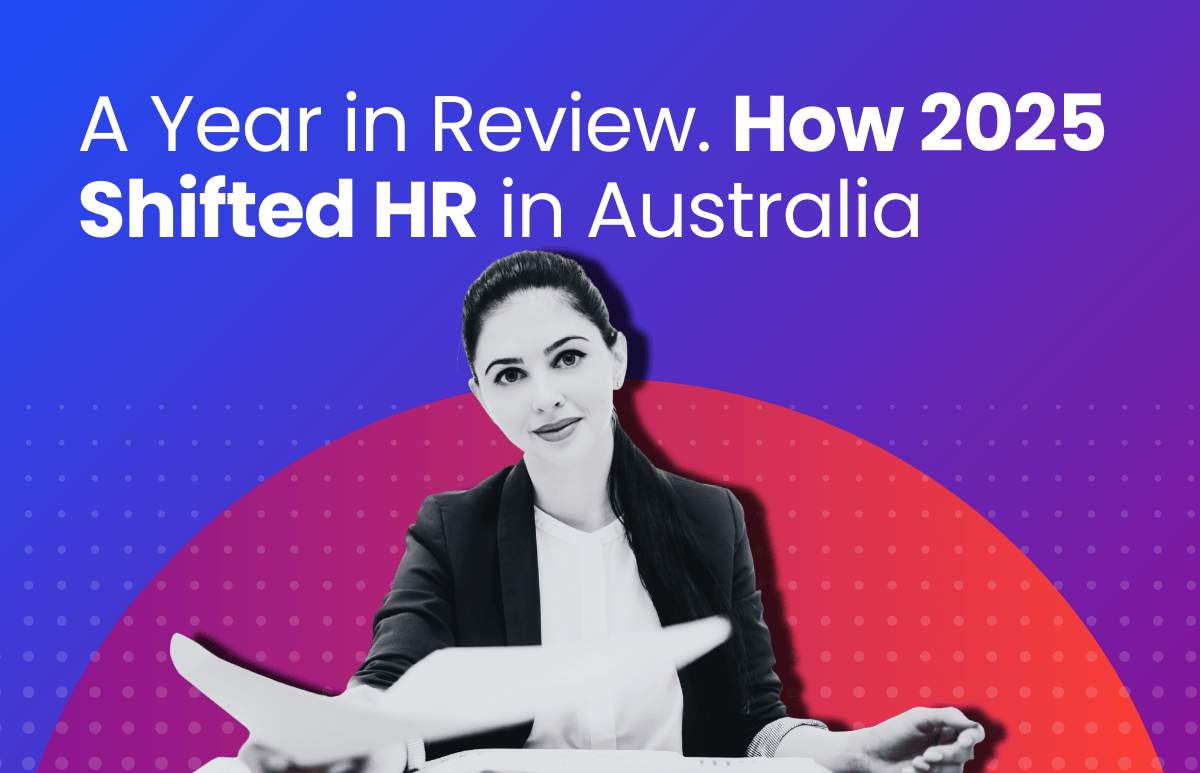
Here at ELMO, we’ve spent the past 12 months gathering insight directly from the people shaping Australia’s workplaces, employees across industries, and the HR professionals supporting them.
Through three waves of our Employee Sentiment Index (ESI), and our flagship annual HR Industry Benchmark Report (HRIB), we built a clear, data-backed picture of where pressure is rising, where momentum grew, and where HR needs to focus next.
ELMO’s ESI tracks the prevailing mood of the workforce. While each quarter explores topical issues, the ‘Index’ gives us a baseline reading of security wellbeing, confidence and future outlook.
The Index began at an underwhelming 69.1 in Q1 (its lowest point in five quarters). Driven by slipping job security, reduced wellbeing and a sharp rise in burnout to 43% (up from 29% in Q4 2024).
By mid year, sentiment hadn’t improved. Burnout remained high at 40%. Almost half of Aussie employees said their income didn’t meet their needs and presenteeism increased. These figures pointed to a workforce doing its best to stay afloat, but not necessarily feeling supported.
By Q3, the Index climbed to 71.4 in a sign of cautious recovery. Confidence and recognition improved, but core challenges persisted. Burnout held steady at 40% and job mobility remained low.
Taken as a whole, consecutive ESIs show that engagement doesn’t equal thriving. Low mobility and high effort can mask underlying strain. Burnout, presenteeism and financial insecurity point to a workforce that’s committed, but stretched.,
While employees were operating under quiet strain, HR was navigating its own pressures. ELMO’s HR Industry Benchmark Report revealed a profession carrying more weight than ever, with growing strategic influence but persistent operational constraints.
At the same time, HR’s strategic role strengthened:
2025 showed that HR doesn’t need more tasks, it needs greater capacity, clearer role definition and the tools to move strategically.
Pay became a symbol for fairness and transparency in 2025.
Employees said performance should determine pay. Many believed profitability actually did. This gap reflects a trust issue more than a financial one.
Mid-year ESI data showed 84% of Australian employees felt their skills were keeping pace with change. On the surface, that sounds reassuring, but the deeper story tells us otherwise. Only 15–20% of employees felt supported to build future‑focused skills such as AI. Most development was informal, not structured. This inconsistency poses a risk as digital transformation accelerates.
The ‘Right to Disconnect’ took centre stage mid-year for Australia. It was timely, and the results were revealing.
This isn’t about policy, it’s about psychological safety (not to mention retention). Trust needs to be actively built, especially around boundaries and wellbeing.
If there’s one thing 2025 made clear, it’s that AI and learning can’t be treated separately. The gap between ambition and readiness is widening and employees are noticing.
Only 54% of Australian employees thought their employer was helpingAI’s impact. This disconnect poses a long-term risk to capability.
AI can accelerate performance, but only when people feel equipped to use it confidently.
Across the year consistent patterns emerged:
Don’t confuse staying with thriving. In 2026, HR will need to improve employee health, not just headcount stability.
HR walked a tightrope this year. Influence grew, but so did expectations. Legacy systems and manual administration limited strategic capacity.
When we look to the year ahead, several themes are clear:
If 2025 was the wake up call, 2026 is the moment to act. The systems, structures and strategies built now will define how resilient, prepared and people-focused organisations can be in the future.
Discover how ELMO helps Australian HR teams reduce admin burden, strengthen workforce capability, and move from reactive to strategic leadership.