By industry
  By role
  By use case
  Customer Success
  Implementation
  Training & Development
 9 things to know about ELMO’s two-way sync between HR and Payroll
Say goodbye to entering the same information in multiple systems. ELMO’s payroll two-way sync now…

 Platform
  Hire
Hire  Schedule
  Pay
Pay  Develop
  Plan
Plan  Partner Program
  Partner Finder
  Partner Stories
  Flare Employee Benefits
 When I joined ELMO as Chief People Officer, I joined because they had done the hard thing first.
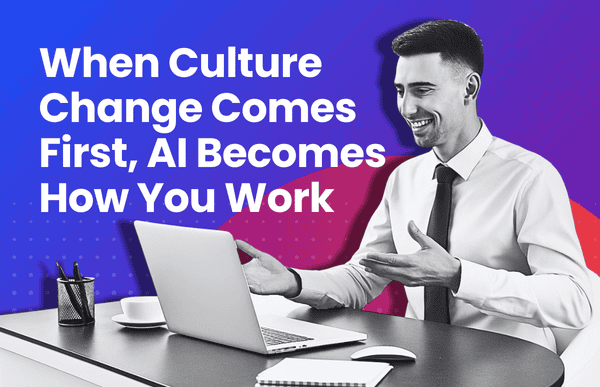
They treated AI as a culture change.
Not a tech rollout.
Not a side project.
They put governance in place.
They aligned leadership.
They invested in capability before chasing hype.
That sequence matters.
When you approach AI as a shift in how people think and work, it moves from interesting to expected. From pilots to platforms.
We started with guardrails. Clear boundaries from Information Security meant people knew what good looked like.
Leadership modelled behaviour. Our President, Joseph Lyons, openly shared how he uses AI. HR and Technology partnered from day one. This was organisation-wide, not function-led.
We invested in learning. An AI Educate Day (eNPS +50) evolved into ongoing training and an AI Champions network. The message was simple: this is part of how we work now.
Culture change first. Capability activation second.
Today, we’re trying to embed AI into all of our daily workflows.
Adoption is tracked. Using AI is not exceptional, it is expected.
We evolved from team pilots to enterprise capability with Glean, connecting systems into a unified knowledge layer across the business.
The impact is measurable:
But we measure more than time saved. We track employee experience and adoption to ensure the shift is sustainable.
HR also acts as customer zero, testing AI-enabled products internally before they go to market.
The real opportunity is elevation.
With AI-powered workforce insights, HR leaders can answer board-level questions in minutes, not weeks. That changes confidence, credibility and influence in decision-making forums.
AI also strengthens workforce design. Instead of reacting to role requests, HR can use AI-enabled capability frameworks to understand skills gaps, guide development and link workforce decisions to productivity and growth.
AI does not deliver value through technology alone.
It delivers value when you:
At ELMO, AI is not a programme.
It is becoming how we work.
If you’ve completed ELMO’s AI Maturity Assessment, you likely fall into one of two categories:
You’ve invested in integrated HR platforms, cleaned your data, put governance in place, and secured leadership buy-in. On paper, you’re ready. In practice, AI adoption is sluggish and the value is still emerging.
Your challenge is activation. Here’s your roadmap:
30 days: Run a focused “from potential to practice” sprint
Choose three to five high-volume use cases that affect many people—such as job ad creation, performance summaries, or manager check-ins—and design simple, AI-supported workflows around them. Use your existing platforms as the default environment, so new habits form where work already happens.
60 days: Turn leaders into visible sponsors
Ask executives and senior leaders to share how they use AI in their own work. This normalises experimentation and signals that “using AI” is not cheating; it’s a capability to be proud of.
90 days: Use your AI-native tools as teaching grounds
If you’re using ELMO’s AI-embedded capabilities, like ELMO Insights or Career Development, build training and examples around those. This ties literacy to your actual systems, not generic tools, and makes it easier to link learning to measurable outcomes.
You’re building momentum on strong foundations. AI is being used but not yet driving significant measurable impact. You’ve proven the value and developed the muscle, now you’re optimising at scale.
Your challenge is strategic elevation. Here’s your roadmap:
30 days: Turn your personal wins into shared assets
Document your most successful workflows: the original task, the prompt you used, the output, and the refinements you made. Work with L&D to turn these into short, practical ELMO Learning modules others can follow.
60 days: Use evidence to advocate for expansion
Combine your AI Maturity Assessment results with tangible time-savings and before/after examples. Use that data to have grounded conversations with leadership about expanding AI-enabled capabilities across all functions.
90 days: Pilot a structured program with volunteers
Run a small group from HR and one or two other teams through a journey based on your best use cases, gather feedback, and measure impact. Their experience becomes your first internal case study for broader rollout.
In both archetypes, the goal is not to “finish” your AI journey. It’s to create enough confidence, trust, and proof that the next phase feels like a natural progression rather than a leap.
Ultimately, AI at ELMO is not just about technology. It’s about people: their creativity, curiosity, and confidence—and their ability to build a valued, trusted partnership with the AI tools they use every day.
What we’ve learned over the past eighteen months is this: when you build psychological safety first, when you pair governance with permission to experiment, when you measure sentiment alongside ROI, and when you evolve your tools as your sophistication grows—AI stops being a pilot and becomes a platform.
We’re not only preparing for the future of work. We’re actively shaping it, putting people at the heart of AI innovation.
Want to see where you sit on the AI maturity curve? Take ELMO’s AI Maturity Assessment to understand your readiness and effectiveness, discover your archetype, and access tailored guidance for your next 90 days.
Book a conversation with our team to see how Insights, Career Development, and our complete workforce platform can help you move from activation to strategic advantage.