By role
  By use case
  Customer Success
  Implementation
New releases in ELMO: What we’re working on in Q1 of FY27
Here’s a snapshot of new product releases this quarter.
4min read
 HR Core
  Payroll
  Recruitment
  Onboarding
  Performance Management
  Learning Management
  Partner Program Partner Finder
  Partner Stories
  Flare Employee Benefits
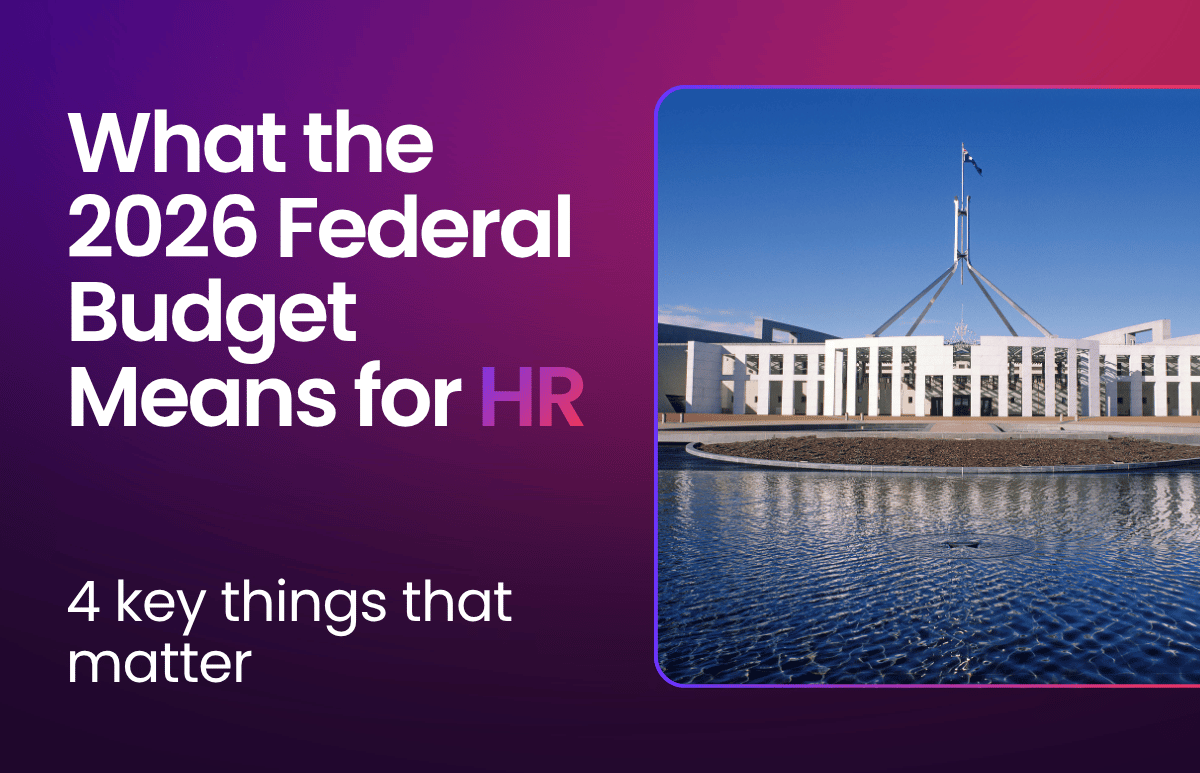
 Last year’s Budget focused on initiatives designed to buttress the economy against future pressures, aimed to balance immediate support with long term economic health.
This year’s Budget was built around three pillars: a productivity and investment package, tax reform for workers and businesses, and a $63.8 billion savings agenda. For sectors such as construction, manufacturing, and IT & Telecoms, the announcements land directly on the challenges HR leaders have already flagged in ELMO’s 2026 HR Industry Benchmark Report (HRIB). Here’s what you need to know for each sector.
The $10.2 billion per year compliance reduction and permanent instant asset write-off are genuine wins. The challenge now is ensuring HR and finance teams have the systems to capture those savings, rather than absorbing them in manual processes.
Faster trades qualifications recognition and migration points test reform could ease some pressure in construction and manufacturing, though healthcare workers move through separate assessment pathways not covered by this specific investment.
For HR leaders, the grants themselves may feel at arm’s length. But it shows the government is actively accelerating the pace at which AI tools will reach Australian workplaces. However, investment in AI without capability building won’t close that gap.
Record hospital and housing investment will drive demand for more workers in already stretched industries. Workforce planning in these industries need to start planning ahead, to avoid bottleneck when pressure peaks.
The negative gearing, CGT and trust changes will generate short-term uncertainty for businesses and their advisors, particularly in financial services and construction, even where the long-term intent is positive.
The budget’s focus for construction centres on housing supply, infrastructure investment and trades workforce development.
Key announcements:
The government’s biggest-ever housing commitment, including a 5% deposit scheme for first home buyers.
Funding for roads, power and drainage to support new housing developments.
Fees of up to $1,600 for accessing mandatory Australian standards used in construction will be scrapped.
Streamlining approvals so projects can move from investment decision to construction faster.
Skilled migrants in trades roles will have their overseas qualifications recognised more quickly, helping ease labour supply constraints.
The $47 billion housing push is going to intensify the demand for construction labour. The HRIB Report for construction shows HR leaders are already under significant pressure. 32% cite upskilling and reskilling as their biggest challenge, while 21% cite ongoing labour shortages across projects.
With a predicted salary increase of 4.4% and a cost per hire of $16,589 in 2026, every hire and every skills gap matters.
See how construction HR leaders can respond >
For manufacturing, the budget targets productivity, supply chain resilience and the ongoing transition to cleaner energy.
Key announcements:
The existing $22.7 billion fund continues, with a focus on cleaner energy and strengthened sovereign manufacturing capability.
Reducing trade barriers and lowering input costs for manufacturers reliant on imported components.
Working to make Australia function as one economy rather than eight, reducing friction for manufacturers operating across state borders.
Certainty for manufacturers investing in new equipment and machinery.
Allows manufacturers to offset current losses against previous profits, providing a buffer during downturns.
Government support for businesses bringing AI-powered innovations to market, relevant to manufacturers looking to automate and modernise operations.
Similar to the construction industry, manufacturing HR leaders are navigating a mix of pressures. Our HRIB for manufacturing reveals 23% are contending with reduced budgets and 23% cite AI adoption as a top concern. Cyber and data security is also their biggest hurdle.
With a 4% predicted salary rise and cost per hire of $17,329, manufacturers who invest in smarter workforce systems will be best placed to keep up as the sector modernises.
See how manufacturing HR leaders can respond >
Healthcare is one of the biggest winners in the 2026 budget, with record investment across hospitals, primary care, aged care and medicines.
Key announcements:
A new five-year funding deal with the states, representing a record investment in public hospital infrastructure and services. Health now accounts for more than 16% of total budget expenses.
Permanent funding for all 137 clinics around Australia. By July, four in five Australians will live within a 20-minute drive of a clinic.
Expanding access to medicines on the Pharmaceutical Benefits Scheme, including treatments for cystic fibrosis (saving some patients up to $250,000 per year).
More beds, more home care packages and improvements to aged care quality.
Specifically prioritising healthcare roles where skills shortages are acute, including nursing, allied health and specialist roles.
The 2026 HRIB shows 25% of healthcare HR leaders name implementing legislative changes as their single biggest challenge. With only 3.9% salary growth predicted, 23% of leaders citing reduced budgets, and a cost per hire of $16,973, the sector is being asked to do more with less.
See how healthcare HR leaders can respond >
The budget takes a productivity-first approach to the digital economy, with AI, digital identity and regulatory simplification as the standout themes.
Key announcements:
Direct government support for businesses developing and commercialising AI innovations, a clear signal that AI investment is a national productivity priority.
Broader rollout of the Digital ID system to speed up government approvals and reduce administrative friction for businesses.
Australians and businesses won’t need to keep submitting the same information to different agencies — a significant time-saving for organisations dealing with compliance and government interaction.
Includes making electronic record-keeping with financial regulators easier and simplifying climate-related financial disclosures — relevant to tech companies navigating ESG reporting obligations.
Single National Market reforms that reduce friction for IT and telecoms providers operating across jurisdictions.
The Treasury noted a solid pipeline of data centre investment as a positive for business investment outlook.
IT and telecoms are already at the sharp end of workforce pressure. ELMO’s HRIB Report shows 32% of HR leaders cite upskilling and reskilling as their top challenge and 31% name expanding AI use across the organisation as a major concern.
See how IT & Telecoms HR leaders can respond >
For financial services, the budget delivers meaningful compliance relief, but also introduces the most significant property tax reform in decades, with ripple effects across the sector.
Key announcements:
Electronic record-keeping with financial regulators will be made easier and climate-related financial disclosures simplified, directly reducing the cost of doing business for banks, insurers and financial institutions.
Investment properties bought after 7:30PM AEST on 12 May 2026 will no longer be eligible for negative gearing from 1 July 2027. This has implications for clients of financial planning and lending businesses.
The 50% CGT discount was replaced with cost-base indexation for assets held more than 12 months, from 1 July 2027. Combined, Treasury estimates the negative gearing and CGT changes will raise $3.6 billion over the forward estimates.
A new minimum tax on income from discretionary trusts from 1 July 2028 (with three-year rollover relief for restructuring). The measure is projected to raise approximately $4.5 billion per year once fully operational from 2029–30.
To encourage investment and innovation, particularly relevant for fintech.
The budget takes a disciplined approach to spending, which has implications for the economic outlook financial services businesses are navigating.
Financial services HR leaders face the largest AI expectations gap compared to the above sectors. With economic outlook as a top challenge alongside cyber threats, and a 4.8% salary rise predicted, there’s a pressure to attract and retain specialist talent in the field.
See how financial and insurance HR leaders can respond >
Federal Budget announcements have not been legislated and may change. The information in this publication is for information purposes only and does not constitute legal advice. For legal advice, please consult a qualified legal professional.