By industry
  By role
  By use case
  Customer Success
  Implementation
  Training & Development
 Education Insights: 2026 HR Industry Benchmark Report
ELMO Software’s 2026 HR Industry Benchmark Report (HRIB) reveals that HR leaders in education are…

 Platform
  Hire
Hire  Schedule
  Pay
Pay  Develop
  Plan
Plan  Partner Program
  Partner Finder
  Partner Stories
  Flare Employee Benefits
 ELMO Software’s 2026 HR Industry Benchmark Report (HRIB) reveals that HR leaders in healthcare are being pulled in multiple directions at once: navigating AI disruption, keeping pace with legislative change, and protecting quality of care under budget pressure. Based on a survey of 1,200 HR professionals across Australia and New Zealand, the report highlights key trends and challenges across all industries, and this infographic focuses on what they mean for healthcare and social assistance.
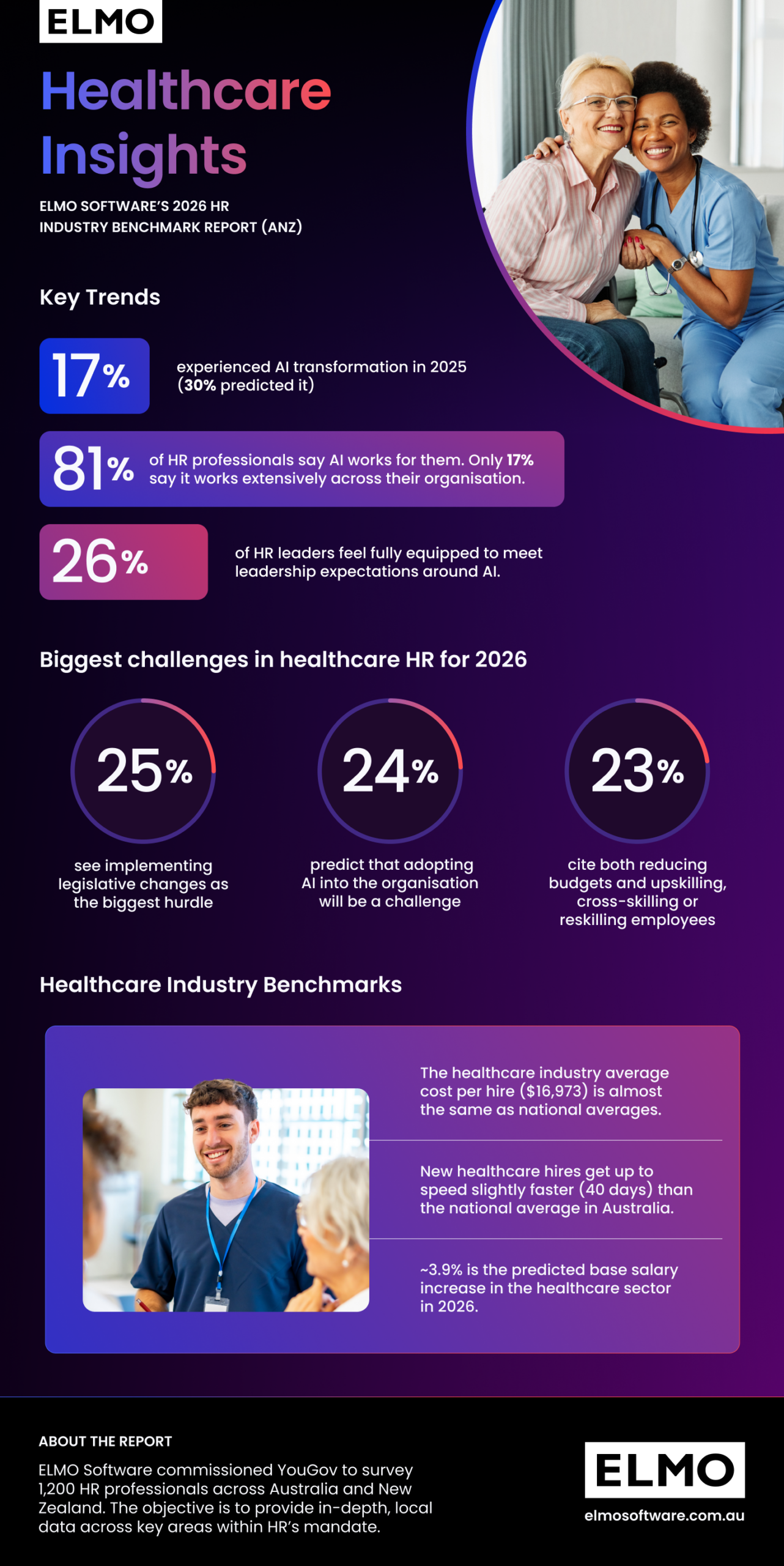
In healthcare, the AI capability gap is clear. Just 17% of organisations say AI was truly transformative in 2025, compared with 30% who predicted it would be the year before. While 81% of HR professionals say AI “works” for them personally, only 17% see it working extensively across their organisation, and just 26% feel fully equipped to meet leadership expectations around AI.
Healthcare HR teams are also facing intense operational and regulatory pressure:
The infographic also highlights core industry benchmarks:
The 2026 HRIB findings give healthcare organisations a grounded view of where AI, regulation and workforce expectations are heading, and what HR can do to respond.
Understanding these trends, and how to tackle them can help you:
Here are some practical ways healthcare HR leaders can respond.
With only 17% of healthcare organisations seeing AI work extensively across the business, there’s a risk of AI fatigue before impact is achieved.
With 25% of healthcare HR leaders naming legislative change as their biggest hurdle, responding ad‑hoc to every new requirement isn’t sustainable.
With 23% citing reduced budgets alongside upskilling and reskilling, many healthcare organisations are being asked to do more with less.
With budgets under pressure and talent in short supply, capability building becomes a strategic lever.
Take our five minute AI Maturity Assessment to see where you sit and get a tailored action plan to help build your organisation’s capability.
Healthcare’s benchmarks offer a realistic lens on cost, timeframes and expectations.
By applying these insights, healthcare organisations can combine AI, regulation‑ready processes and human judgment to build HR practices that support both workforce wellbeing and high‑quality care.
ELMO is the Complete AI Workforce Platform for mid‑sized organisations across Australia and New Zealand. It unifies HR and payroll on one connected data foundation and layers native AI to turn workforce data into insight and action — helping healthcare providers manage compliance, talent shortages and changing models of care with greater confidence.
Within the platform, specific solutions can help address healthcare’s 2026 challenges:
HR Core centralises employee records, contracts, credentials and qualifications in one system, helping you stay audit‑ready across multiple sites and services. Automated workflows and reporting support your compliance needs, while strong security controls help protect sensitive employee and patient‑adjacent data.
Paired with Payroll, you can manage complex award rules, shift penalties and allowances accurately, reducing pay errors and providing HR, Finance and leaders with a single, reliable view of workforce costs.
With hiring costs in line with national averages and talent in short supply, every vacancy matters. ELMO Recruitment helps healthcare organisations find and hire the right people faster, with structured workflows that reduce manual admin for busy hiring managers.
AI‑assisted features support screening and shortlisting, so teams can focus on high‑value conversations with candidates while maintaining clear, compliant recruitment records.
In a sector where continuous education is essential, ELMO Learning helps you deliver and track compliance, clinical and professional development programs at scale, and ELMO’s Career Development solution helps you understand current capabilities, identify gaps and guide clinicians along clear career development pathways.
You can:
Centralised reporting makes it easier to evidence compliance to regulators and boards, and to identify where further support is needed.
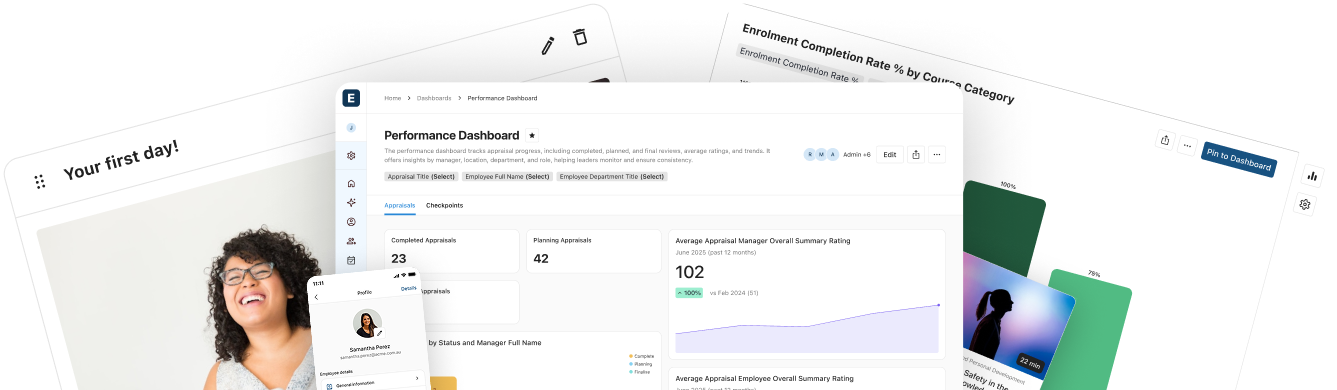
Retention is critical when budgets are tight and skills are scarce. ELMO Performance Management connects goals, feedback and development plans, giving leaders a structured way to recognise performance and support growth.
Performance insights can be used to:
Real‑time reporting helps HR and executives make more informed decisions about workforce design, succession and where AI and automation can complement care teams.
Explore the full infographic for a visual snapshot of healthcare’s AI readiness, regulatory pressures and workforce benchmarks — then use the insights to test and refine your 2026 workforce and compliance strategy.
Complete the form and one of our consultants will be in touch with you shortly to discuss how ELMO’s Complete AI Workforce Platform can support your healthcare organisation.