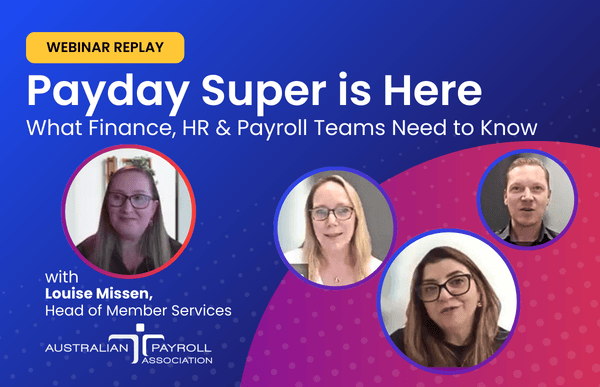
Payday Super is Here: What Finance, HR & Payroll Teams Need to Know
Payday Super is now law, rolling out from 1 July 2026. It’s more than a compliance requirement; it’s a catalyst for rethinking how Finance, HR, and Payroll work together. Watch our latest webinar to explore what’s changing, what it means for your business, and how to prepare strategically.
Frequently asked questions
Under the new legislative, Super frequency must match your pay cycle.
Yes, primarily because the final quarter of FY26 (April-June) is usually paid in July 2026. It “collides” with the new PayDay Super payments in the 2026/2027 tax year, resulting in 15-months of contributions landing in one year. It will affect those who pay their Super Quarterly.
Helen addresses this in our webinar; check out the recording above starting at the 11-minute mark.
Nothing, it is only if they exceed their employee concessional cap. They may be taxed higher, however, they should check with their super fund.
It may be correct depending on which award. Helen addresses this in the recording above.
We did not offer financial incentives or other “sweeteners” as part of the transition from fortnightly to monthly pay. Instead, we treated the shift as a significant change-management exercise, underpinned by a strong communication and education plan to build employee confidence and highlight the benefits for employees, including superannuation being paid earlier and the potential for higher investment returns. This included clear, early messaging on the rationale and impacts, comprehensive FAQs, and defined pathways for employees to ask further questions and seek clarification. Because the change was well planned and well communicated, employee concern and resistance were very limited.
We are working with our payroll and clearing house partners to confirm how Payday Super will be priced, including any impact of moving from quarterly to more frequent super processing. We will share details once they are confirmed.
Yes, for the first contribution for a new employee or a new super fund, employers have up to 20 business days from that first payday to ensure the payment is received by the fund.
No, you still need to provide them with the super choice form
We have a series of Payroll webinars coming up to help you navigate the next few months. The next one is ‘Your Guide to Payday Super & Termination Compliance’ on Tuesday, 24 March, keep an eye on your inbox. For the invite!
As long as the superannuation hits the employees’ super fund within 7 business days from the 1st of July. You should check with your clearing house how long it will take.
This information has not been provided by the ATO yet.
Errors for past periods are “late payments” and must be handled via the SGC Framework. The “Out of Cycle” rule is specifically for planned irregular payments (like bonuses) made between regular paydays
Yes, you will pay 12% on the employees’ QE until they hit the MSCB if that is what the employer chooses, or you can continue to pay 12% on all QE. If you choose to cap it, once they hit the limit, they will no longer receive superannuation till the new financial year.
Fund Validation Services (FVS) – this is what provides employers with alerts and timely notification about key changes to large super funds, such as fund mergers or non‑compliance issues.
Superannuation details are valid during onboarding or changes in super? i.e. errors can be picked up at time of entry rather that with Super payments.
Our payroll partner is designing fund‑validation (FVS/MVR) at onboarding and when super funds change, so errors can be picked up at entry rather than at payment. We are working with them to confirm how this will surface for ELMO HR Core and will share more once the design is final.
No, it must be 12% on the QE until they hit the MSCB limit.
STP changes for Payday Super are being designed by our payroll partner. At this stage there are no specific UAT requirements for ELMO, but we are working with them on the details and will communicate any partner testing expectations once agreed.
For staff on Total Fixed Remuneration (inclusive of base, super, and benefits) rather that a “Base Salary +” model, deducting the super liability creates a ‘lumpy’ salary profile. Super deductions will be higher early in the year (due to the new annual MCB), reducing cash salary until the cap is reached.
Is the market favouring constant TFR (resulting in fluctuating net pay) or constant Base Salary (employer absorbs the cash flow variance)? I’m concerned the latter risks ‘overpaying’ super for employees who terminate early in the financial year.
You must be 12% on the QE until they hit the MSCB limit. If they are paid a TRP, then you would get the TRP amount, divide it by 12 months (if paid monthly) and then calculate the QE and the super until they hit the MSCB, and then you will pay the full amount as salary. We will have examples in the workshop on this. You should also check the employee’s contract on this.
Our understanding is that there are currently no planned changes to the existing direct‑debit clearance approach. We are continuing to work with our partners on the final position and will update customers if this changes.
The requirement for employee phone numbers in super lodgements is still being clarified. We are working with our payroll partners to confirm data requirements and will share guidance once we have a firm view.
No you can start now. Just discuss this with your Finance team.
MVR is being implemented at platform level by our payroll partner rather than as a Beam‑only feature. We are working with them on how this capability will be exposed for ELMO Payroll and integrated customers, and will provide more detail as it is confirmed.
From the official payday, as per the STP reporting.
You can submit it when you like as long as it is in the employees super fund within 7 business days of their regular payday.
For your new hires, you have 20 business days to have their super within their fund.
Yes, you should check with your system provider.
Kath addresses this in her section of the webinar, check it out in the recording above (she’s the first speaker).
Yes! We will host our next webinar on Tuesday 24 March, keep an eye out on your inbox for details.
HR Core