By industry
  By role
  By use case
  Customer Success
  Implementation
  Training & Development
 Australian workers feel fairly paid even as financial security tumbles
New research reveals cost-of-living pressures continue to weigh on Australian workers, despite easing concerns about…

 Platform
  Hire
Hire  Schedule
  Pay
Pay  Develop
  Plan
Plan  Partner Program
  Partner Finder
  Partner Stories
  Flare Employee Benefits
 New ELMO research finds majority of Australians see AI as an advantage at work, but growing divide risks leaving some workers behind
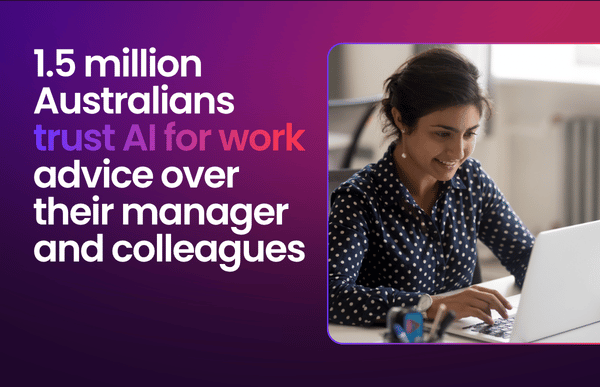
29 July 2026 – Around 1.5 million Australians are turning to AI before their manager or colleagues at work for advice, the latest ELMO Employee Sentiment Index (ESI) report found.
The report, covering January – June 2026 and surveying over 1,000 Australian employees, found 14% of Australian employees would ask AI tools for work advice first, mostly due to speed (57%), convenience (44%), better quality responses (44%) and to avoid bothering their team (28%).
This almost doubles among senior leaders and business owners – 26% would turn to AI tools over managers and colleagues. A further 44% – or approximately 4.7 million Australians – say it depends on the task.
While most employees only started using AI tools in the past 12-18 months, many Australians now see the technology as a trusted advisor on par with their team. More than seven in 10 (72%) Australians now use AI tools at work, and 41% use it regularly in repeatable workflows, across multiple tasks or to automate tasks. Two-thirds (66%) believe it’s helpful to their role.
While Australians are generally optimistic about AI, they also see it as a source of pressure. Almost two in three (65%) say it’s now an expected skill, 72% agree that if AI helps workers go faster, more is expected of them, and 58% say people who don’t use AI risk falling behind. Almost half (49%) have felt uncomfortable with how AI is used at work.
ELMO Software President Joseph Lyons said the findings point to the need for organisations to focus on the systematic and regulated integration of AI in the workplace, not just adoption.
“With adoption high, the question now is how organisations can systemise AI so it’s a trustworthy single source of truth. Australian organisations are still struggling with unregulated shadow AI tools being used, and many employees aren’t always comfortable with how AI is used in the workplace,” he says.
“Organisations need to consider not only when employees should use AI, but how to validate its output and when it should be trusted over a human. Like any widespread change, this takes a consistent, planned approach. Regulated use won’t happen organically.”
Divide between AI users and non-users
The data reveals there’s a clear divide between those who do and don’t use AI at work. AI usage is more prevalent among those under 50 (80% vs 49% of 50-64 year olds), salaried employees than those paid hourly (84% vs 58%) and those earning over $100k (83% vs 65%). Generally, the higher an employee’s income, the more sophisticated their use of AI; 64% of high income earners ($170k+) use it in a regular, automated way.
The divide extends beyond demographics to attitudes; While many non-users don’t see AI as helpful to their role (64%), don’t view it as an expected workplace skill (50%) and don’t expect it to significantly impact their organisation (46%), regular AI users are far more positive. Nearly nine in ten (87%) say AI is helpful, 84% see it as an expected skill and 74% believe non-users risk falling behind.
“Some people are always slower to embrace new technology, but employers must focus on managing change, not just the tools themselves, to avoid workers being left behind,” says Lyons. “The good news is the more employees use AI, the more they see the benefits.”
Surprisingly, Australians who regularly use AI are more likely than non-users to have felt uncomfortable with how it’s used in the workplace (59% vs 36%) and see their skills as AI-proof (72% vs 62%).
“Sophisticated users of AI don’t see the technology as perfect, but they have a clearer view of its strengths and weaknesses,” says Lyons. “This is a huge advantage when building that systematic AI approach.”
Australians sick and burnt out as financial pressure grows
Beyond AI, the data reveals Australians are feeling other pressures at work and home. Just under half (44%) of employees feel burnt out (up from 39% in H2 2025) despite taking more annual leave recently (42%). Meanwhile, 46% have taken a legitimate sick day and 41% have gone to work unwell in the past six months.
Compared with six months ago, the number of Australians who feel economically secure dropped sharply in the first half of 2026. Less than three in 10 (28% vs 37%) say they’re economically secure and two in five (40%) say they don’t earn enough, although 72% believe they’re fairly paid for the work they do, indicating a gap between what’s fair and what’s needed for the current cost of living.
While Australians are more concerned about their finances, they’re feeling slightly more secure in their jobs. Fewer Australians are concerned about redundancy (34% down from 39% in H2 2025) but only 45% feel secure in their role.
“While employers can’t control the broader economic landscape, they can consider how they support their team’s overall physical and mental wellbeing in these conditions, whether through flexible working arrangements, mental health days or extra support,” says Dr Amantha Imber, organisational psychologist, AI consultant and ELMO partner.
-ENDS-
About ELMO Software
Founded in 2002, the ELMO Group comprises ELMO Software, Breathe HR and Rotageek. ELMO Group is a multinational provider of people management solutions, trusted by over 18,000 organisations across Australia, New Zealand and the United Kingdom.
ELMO is The Complete AI Workforce Platform™. It unifies HR and Payroll on one connected data foundation and layers native AI to turn workforce data into insight and action. ELMO’s mission is to get Australia and New Zealand’s workforce ready for what’s next and supports the full employee lifecycle, from recruitment and onboarding to learning, performance, payroll and more.
Backed by ISO-certified security, Australian-based data hosting and local experts who guide change throughout the journey, ELMO helps mid-sized organisations build the foundation for AI-ready workforces of tomorrow.
For more information, visit www.elmosoftware.com.au or follow ELMO Software on LinkedIn.
About the ELMO Employee Sentiment Index
The ELMO Employee Sentiment Index offers a half-yearly pulse check on the actions, attitudes and behaviours of Australian employees. It tracks changes in perceptions around job security, wellbeing and the economy, as well as topical issues impacting Australian employees.
The research was commissioned by ELMO Software and conducted by YouGov. 1,068 Australian employees were surveyed online, aged 18-64 (excluding self-employed employees) between 1 and 7 July 2026. Respondents were asked to reflect on the six-month period between January 2026 and June 2026.
Respondents were members of a permission-based panel, geographically dispersed throughout Australia including both capital city and non-capital city regions. After surveying, the data was weighted to the latest population estimates sourced from the Australian Bureau of Statistics.