By industry
  By role
  By use case
  Customer Success
  Implementation
  Training & Development
 Financial & Insurance Insights: 2026 HR Industry Benchmark Report
ELMO Software’s 2026 HR Industry Benchmark Report (HRIB) reveals that HR leaders in financial and…

 Platform
  Hire
Hire  Schedule
  Pay
Pay  Develop
  Plan
Plan  Partner Program
  Partner Finder
  Partner Stories
  Flare Employee Benefits
 ELMO Software’s 2026 HR Industry Benchmark Report (HRIB) reveals that HR leaders in education are navigating a fast-moving mix of AI change, employee turnover and economic pressure. Based on a survey of 1,200 HR professionals across Australia and New Zealand, the report highlights key trends and challenges across all industries, and this infographic focuses on what they mean for education organisations.
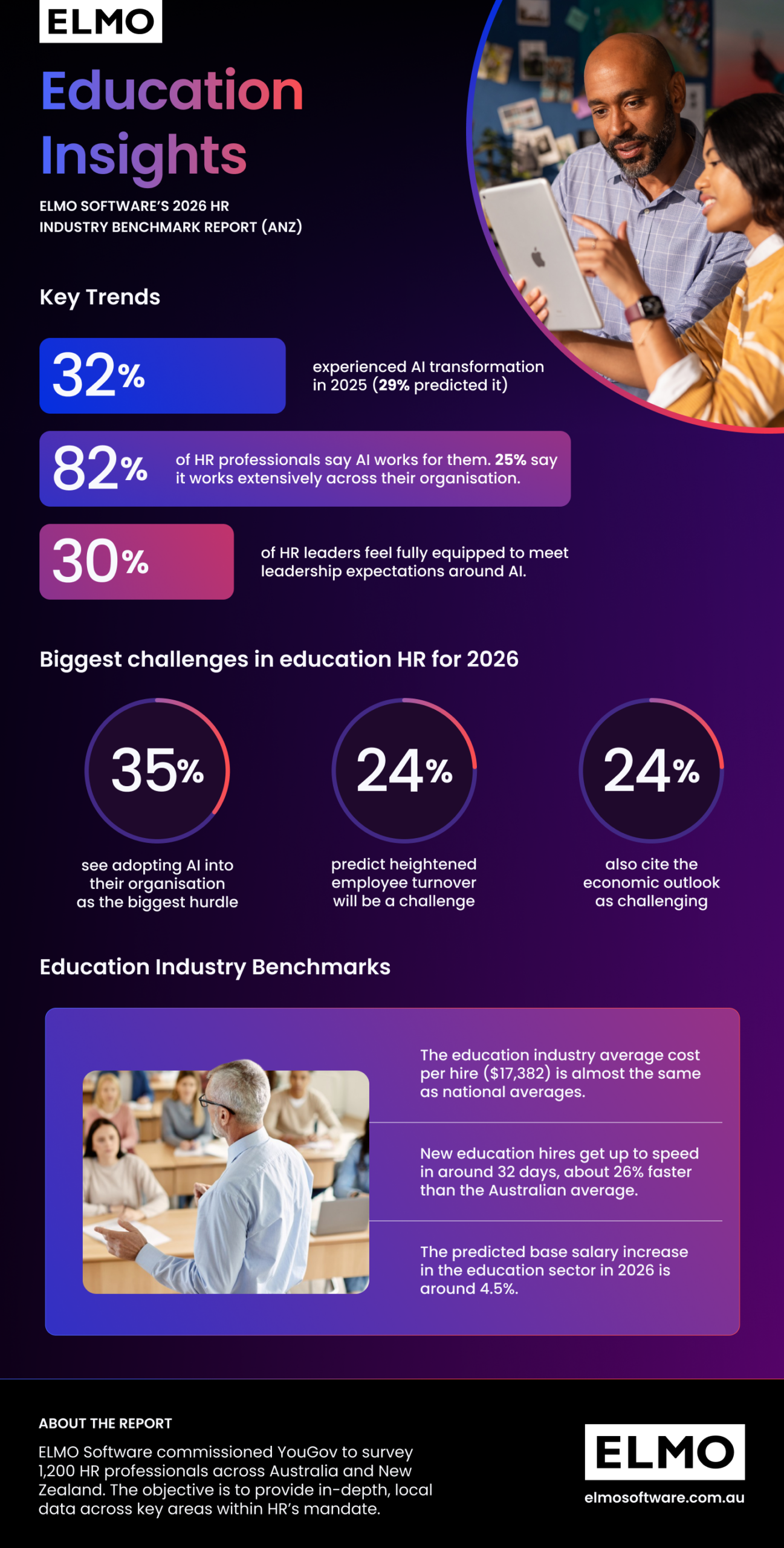
In education, the AI story is notably more positive than in other sectors. It is the only industry where reported AI transformation outpaced the previous year’s expectations, with 38% of organisations saying they experienced AI transformation in 2025, despite only 30% predicting it would happen the year before. At the same time, 82% of HR professionals say AI works for them personally. Still, only 25% say it works extensively across their organisation, and just 30% feel fully equipped to meet leadership expectations around AI.
Education HR teams are also managing significant workforce and financial pressure:
The infographic also highlights key industry benchmarks:
The 2026 HRIB findings give education organisations a clear view of where AI, retention and workforce pressures are heading — and where HR can have the most impact.
Understanding these trends, and how to respond, can help you:
Here are some practical ways education HR leaders can respond.
With 35% of education HR leaders saying AI adoption is their biggest hurdle, the challenge is no longer whether AI matters — it is how to introduce it in a way that feels useful and responsible.
With 24% citing heightened employee turnover as a major challenge, retention needs to be treated as a strategic priority.
With another 24% citing the economic outlook as challenging, education organisations need to make deliberate, evidence-based decisions about where to invest.
While 82% of HR professionals say AI works for them personally, only 25% say it works extensively across the organisation. That signals a capability gap between individual use and organisational adoption.
Education’s benchmarks offer a practical lens on cost, speed and expectations.
By applying these insights, education organisations can combine AI, people data and human judgment to build HR practices that are more sustainable, more strategic and better equipped for the year ahead.
ELMO is the Complete AI Workforce Platform for mid-sized organisations across Australia and New Zealand. It unifies HR and payroll on one connected data foundation and layers native AI to turn workforce data into insight and action — helping education organisations manage AI adoption, retention and workforce pressure with greater confidence.
Within the platform, specific solutions can help address education’s 2026 challenges:
HR Core centralises employee data and automates manual HR processes, giving education organisations a single source of truth across teaching, operational and support roles. Detailed records, automated workflows and reporting help reduce admin burden and support compliance.
Paired with Payroll, you can manage pay structures, allowances and employment variations accurately, reducing the risk of errors and providing HR, Finance and leaders with a reliable view of workforce costs.
With the cost per hire sitting at $17,382 and new hires taking around 32 days to get up to speed, every hiring decision matters.
ELMO Recruitment helps education organisations find and hire the right people faster, with structured workflows that reduce manual admin and keep hiring managers aligned. Combined with Onboarding, you can create a smoother start for new employees, reduce time-to-productivity and give them the support they need from day one.
In a sector where expectations, tools and responsibilities are evolving quickly, ELMO Learning helps you deliver and track learning programs at scale.
You can:
Centralised reporting helps you understand who has completed training, where gaps exist, and where further support may be needed.
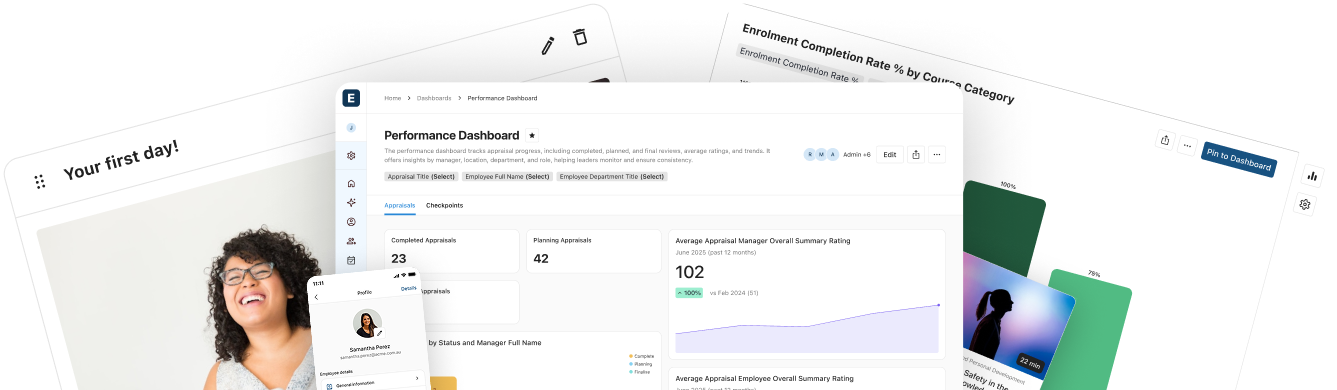
ELMO Performance Management links goals, feedback and development plans so leaders can have more structured, meaningful conversations about performance and growth.
Performance insights can help you:
Real-time reporting gives HR and leaders access to more accurate performance data, supporting better workforce planning and more confident decision-making.
Explore the full infographic for a visual snapshot of education’s AI readiness, turnover pressures and workforce benchmarks — then use the insights to refine your 2026 workforce and retention strategy.
Complete the form and one of our consultants will be in touch with you shortly to discuss how ELMO’s Complete AI Workforce Platform can support your education organisation.