By industry
  By role
  By use case
  Customer Success
  Implementation
  Training & Development
 Hidden payroll work: 7 steps to audit your payroll process
Your payroll runs, but hidden spreadsheets and manual checks may be costing you more time…

 Platform
  Hire
Hire  Schedule
  Pay
Pay  Develop
  Plan
Plan  Partner Program
  Partner Finder
  Partner Stories
  Flare Employee Benefits
 Performance management came up as one of HR’s top priorities for 2026 in ELMO’s HR Industry Benchmark Report, and 360-degree feedback sits at the heart of it.
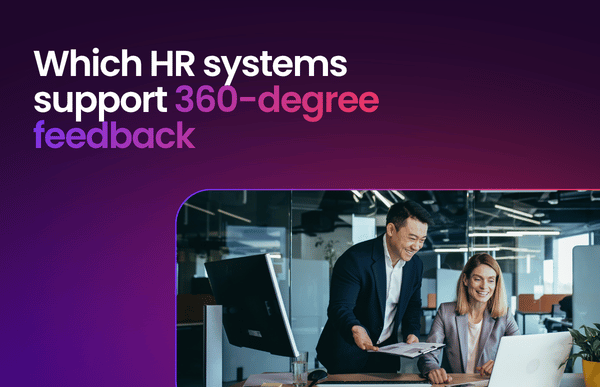
Today, 360-degree feedback (or 360 feedback) has shifted from a specialist HR exercise to a standard part of how organisations manage performance. Instead of a single manager’s view, employees are reviewed by the people they work with: their managers, peers, direct reports, and themselves.
Today, many modern HR and performance platforms offer 360-degree feedback as a built-in capability or connected module. Instead of relying on a single manager’s view, these systems collect feedback from multiple perspectives such as managers, peers, direct reports and self-assessments to create a fuller picture of performance.
Many integrated HR and performance management platforms today include 360-degree feedback as a built-in module. This includes software like ELMO Software, Lattice, Culture Amp, SAP SuccessFactors, Workday, BambooHR, Deel and Leapsome.
In each of these systems, an employee is reviewed by their manager, peers, direct reports and themselves, with the results feeding into goals, development plans and reporting.
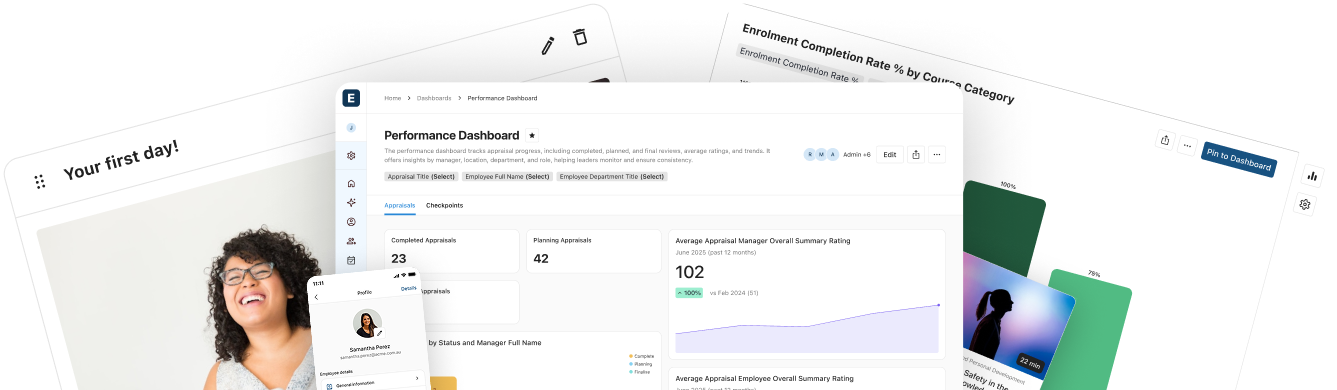
| For mid-market organisations across Australia and New Zealand, ELMO Performance includes 360-degree feedback as part of The Complete AI Workforce Platform™. Feedback is gathered against a behavioural competency library and sits within a connected platform that helps link performance conversations to development, recognition and succession planning. |
Here’s how leading HR systems approach 360-degree feedback.
| System | 360 feedback approach | Best for | Platform scope |
|---|---|---|---|
| ELMO Performance | Manager, peer, direct-report & self reviews against a behavioural competency library; connects to Learning, Reward & Recognition and Succession | Mid-market ANZ orgs wanting one platform | The Complete AI Workforce Platform™ |
| Lattice | 360 reviews tied to development plans and career tracks | Mid-to-enterprise performance + engagement | Performance & engagement |
| Culture Amp | 360 feedback paired with deep engagement analytics | People-analytics-led teams | Performance & engagement |
| SAP SuccessFactors | Enterprise-grade 360 within a full Human Capital Management (HCM) suite | Large, complex organisations | Full HCM |
| Workday | Multi-rater feedback inside a broad cloud-based HCM platform, also has an app for 360 feedback | Large enterprise | Full HCM |
| BambooHR | 360 feedback within a core HR platform | Small-to-mid business | Core HR |
| Deel | Self, manager, team & peer reviews via Engage | Global or distributed teams | Global payroll + HR |
| Leapsome | Customisable 360 reviews linked to learning paths | Growing, development-focused orgs | Performance & learning |
There are pros and cons to running 360 feedback through your HR platform or a separate tool.
| As an integrated platform | As a standalone tool |
| Feedback connects automatically to employee goals, learning and succession. There’s one system to manage and one source of truth. This means HR teams spend less time on admin, moving data between tools. | It can offer deeper survey customisation for one-off or highly specialised projects. The trade-off is that results stay disconnected from the rest of your performance data. |
Did you know? Just 23% of Australian organisations operate from a fully centralised platform across HR, payroll and workforce management. And 40% cite data reliability as their top challenge. (Source: ELMO HR Industry Benchmark Report 2026).
That’s why where your 360 feedback lives matters — disconnected systems make it harder to turn feedback into action.
| With ELMO, your 360 feedback is gathered against a behavioural competency library that sits within a connected platform that helps link performance conversations to ELMO Learning, Reward & Recognition and Succession. |
Features can look similar on a comparison page. Here are three things to help you differentiate:
What is 360-degree feedback in performance management?
Rather than a single manager review, 360-degree feedback collects input on an employee from multiple sources such as their manager, peers, direct reports and themselves. Inside a performance management system, these results feed into goals, development plans and analytics instead of a standalone report.
Which HR systems support 360-degree feedback?
HR and performance platforms that support 360-degree feedback include ELMO Software, Lattice, Culture Amp, SAP SuccessFactors, Workday, BambooHR, Deel and Leapsome. Integrated HR suites build 360 in as a module so feedback connects to goals, learning and succession, while standalone tools handle the survey only.
Is 360 feedback better in a full HR platform or a standalone tool?
For many organisations beyond the early-growth stage, a platform with built-in 360 feedback is often easier to manage than a standalone tool because it connects feedback directly to goals, development and succession without extra admin.
Does ELMO support 360-degree feedback?
Yes. ELMO Performance includes 360-degree reviews, gathering feedback from managers, peers, direct reports and the employee against a behavioural competency library. It connects to ELMO Learning, Reward & Recognition and Succession, so feedback flows into development plans and workforce analytics inside one platform.
How often should organisations run 360-degree reviews?
Most organisations run 360 reviews annually or on an 18-month cycle, ideally aligned to an existing performance or development cycle. Running them too often can create rater fatigue, while running them too infrequently makes behaviour change harder to track over time.
See how ELMO turns your workforce data into insight and action by connecting 360 feedback to goals, learning and succession.