By industry
  By role
  By use case
  Customer Success
  Implementation
  Training & Development
 Hidden payroll work: 7 steps to audit your payroll process
Your payroll runs, but hidden spreadsheets and manual checks may be costing you more time…

 Platform
  Hire
Hire  Schedule
  Pay
Pay  Develop
  Plan
Plan  Partner Program
  Partner Finder
  Partner Stories
  Flare Employee Benefits
 What's driving turnover, where is engagement slipping and how is performance tracking across teams? These are some questions HR leaders are being asked today.
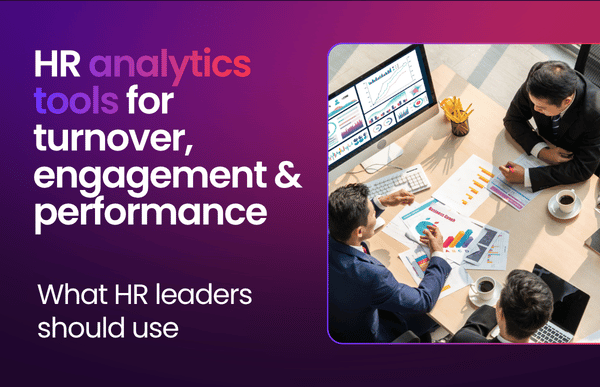
Getting answers fast, or waiting days for a report often comes down to one decision: a separate people-analytics platform you feed your HR data into, or analytics built into the HR system where that data already lives.
Here’s what to look for, and why where the analytics live matters as much as what they measure.
| There are two broad kinds of analytics tools for turnover, engagement and performance: standalone people-analytics platforms that connect to your HR systems, and HR platforms with analytics built in. With built-in analytics like ELMO Insights, HR leaders can ask workforce questions in plain English and get visual answers from connected platform data without relying on a separate reporting tool, helping surface the insights they need from workforce planning to compliance tracking. |
Many “best HR analytics tools” lists are dominated by standalone people-analytics platforms such as Visier, Crunchr or ChartHop. They can be powerful for advanced modelling and workforce planning, but they typically sit alongside your core HR systems and depend on connected source data, governance and refresh cycles. For an HR leader, that shapes how quickly a question can turn into an answer.
When analytics live inside the HR platform, they run on connected platform data with dashboards refreshed hourly. That reduces the need for exporting, manual reporting and separate reporting workflows. With AI assistance like ELMO Insights, leaders can ask questions in plain language, such as “Which departments have the highest turnover?” and get instant visual answers drawn from the same platform source of truth.
A dedicated people-analytics tool can offer advanced modelling, benchmarking and scenario planning, which may suit larger enterprises with a mature data function. The trade-off is that insights often depend on integrations, governance and data refresh cycles, and they may sit in a tool separate from the HR workflows where decisions are made.
The clearest ROI of built-in analytics is time back for your HR team. In a Forrester Total Economic Impact™ study commissioned by ELMO Software, what once took half a day to produce (pulling data, consolidating spreadsheets, preparing reports for the board) now takes just 15 to 30 minutes*.
A group manager of people and culture, healthcare and social assistance described it plainly: “We didn’t have any reporting before because everything was manual. The only data we had was out of our payroll system and then we would manually manipulate that data to create [slide decks] and graphs.”
The same study also found a 129% ROI and payback in under six months.
An Executive General Manager of People and Culture, Healthcare and Social Assistance, “we see ELMO as a fifth member in our team,” and were “able to get to market a lot quicker than we could previously due to a number of roadblocks in terms of administration processes which are now all streamlined into a system.”
What HR analytics tools give HR leaders insights into turnover, engagement and performance?
Options range from standalone people-analytics platforms such as Visier, Crunchr to to platform-native analytics inside HR systems such as ELMO Insights and Workday. Platforms such as Culture Amp can also provide people insights alongside engagement capabilities. ELMO Insights lets HR leaders ask workforce questions in plain English and returns visual answers from connected platform data.
What is the difference between a people-analytics tool and built-in HR analytics?
A standalone people-analytics tool sits on top of your HR systems and depends on connected source data, governance and refresh cycles before users can analyse it.
Built-in analytics, like ELMO Insights, run inside the HR platform so leaders can ask questions directly against connected platform data without exporting or re-keying information into a separate reporting tool.
How do HR analytics tools help reduce turnover?
They surface patterns by department, team, tenure and other workforce dimensions, helping HR leaders spot issues earlier and act faster. When those insights sit alongside broader platform data, they are easier to use in day-to-day workforce decisions rather than waiting for a quarterly report cycle.
Does ELMO have HR analytics for HR leaders?
Yes. ELMO Insights is an AI-powered analytics layer across the ELMO platform. HR leaders and managers can ask questions in plain English and get visual answers from connected platform data spanning HR, recruitment, learning and performance.
*Figures from The Total Economic Impact™ of ELMO Software, a commissioned study conducted by Forrester Consulting on behalf of ELMO, June 2025. Results reflect a composite organisation (an ANZ healthcare org, 500 employees, HR team of 7) based on interviews with four ELMO customers. The study states it is not intended as a competitive analysis and individual results will vary.
See how Patterson Cheney transformed HR reporting across 950 employees with ELMO Insights.