By industry
  By role
  By use case
  Customer Success
  Implementation
  Training & Development
 9 things to know about ELMO’s two-way sync between HR and Payroll
Say goodbye to entering the same information in multiple systems. ELMO’s payroll two-way sync now…

 Platform
  Hire
Hire  Schedule
  Pay
Pay  Develop
  Plan
Plan  Partner Program
  Partner Finder
  Partner Stories
  Flare Employee Benefits
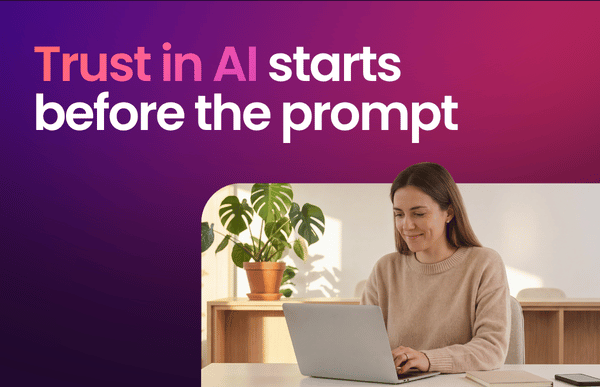
 Trustworthy AI does not begin with a better prompt. It begins with reliable data, clear processes and people who know when to step in.
Key takeaways:
Every generation experiences a technology shift that changes how we work and communicate. For myself, it was the move from an analogue childhood to a hyperconnected digital world.
Now, AI is taking that shift one step further, helping us access information twice as fast, summarise it, interpret it and recommend a course of action.
It’s also changed who we turn to for help.
The 2026 ELMO Employee Sentiment Index (ESI) found that one in seven Australian employees — around 1.5 million people — turn to AI before asking a manager or colleague for help at work. Among senior leaders and business owners, that figure rises to 26%.
This is not to say that employees are abandoning their colleagues or managers. They’re using the resource that seems most useful at the moment and the reasons are practical.
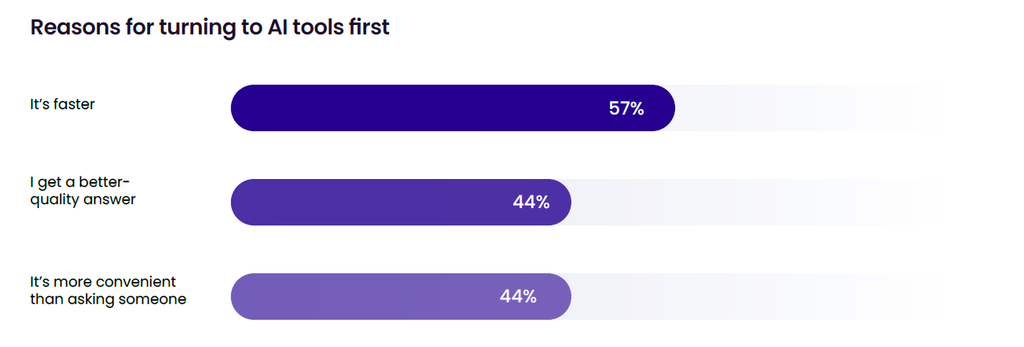
Among those who choose AI first, 57% say it’s faster, while 44% cite better quality answers and 44% say it’s more convenient.
AI is becoming part of how I work across revenue operations and growth.
In my day-to-day, I use it to automate repetitive work, analyse data, build models, summarise large volumes of performance history and find the right information across policies and processes.
I also use it as a thought partner to help me test an approach, challenge my assumptions and work through different scenarios.
More recently, I have also been using agentic workflows that can take a defined task, work through the steps and return a useful deliverable.
However, I would caution that AI should not take your thinking away.
Lean on it when you have reliable context and the task is repeatable, information-heavy and low risk.
A useful way to think about it is this:
| If the work is… | AI should… | Humans should… |
|---|---|---|
| Repeatable, information-heavy, low-risk work | Take the first pass and surface patterns | Review exceptions and apply judgement |
| Sensitive, ambiguous or high-consequence work | Provide summaries and supporting information | Make the final decision |
| Cross-functional, organisation-wide work | Surface patterns and priorities | Build the system, guardrails and source of truth |
A caveat I’d like to add is there are times where the missing context is not a data-quality problem. If a decision depends on sensitive information, relationships, emotion, ethics or judgement, a human should make the final call.
Sensitive HR matters are a clear example of when a human needs to overrule AI.
Tone, body language, intent and trust can all change the meaning of an interaction. AI cannot reliably infer what it has never been given. Whilst AI can prepare you for the conversation, it cannot be the conversation.
Trust in AI is not created when we type in a prompt.
I’ve spent much of my career thinking about automation, modelling and how to build better systems. The principle I always keep coming back to is this: AI will only be as good as the data that goes into it and the context that it has.
It’s earned through the quality of an organisation’s data, knowledge and processes.
In my world, when information is fragmented across a customer resource management (CRM), call recordings, spreadsheets, email threads and separate knowledge bases, competing versions of the truth can emerge.
A source of truth does not necessarily mean storing everything in one central system. It means making sure the information is coherent, maintained and clearly owned. It also means deciding which source takes priority when information conflicts, and where human approval is required.
The better the data and context, the less time people need to spend checking routine outputs. Where data is incomplete or the consequences are higher, the guardrails need to be stronger.
An AI’s output should not be automatically final. It still needs to be fact checked. The goal is to understand the level of confidence an AI output deserves and match the review process to the risk, so we don’t have to manually challenge every low-risk answer.
Technology can move faster than people’s ability to keep up with it. That feeling is often described as technostress, and it can create understandable concerns about being left behind or replaced.
The 2026 ELMO Employee Sentiment Index also found that 49% of Australian employees felt uncomfortable with how AI was being used at work.
That is a reminder that AI adoption is also a people project. I believe some of that discomfort could come from technostress (the feeling that technology is moving faster than our ability to keep up).
Organisations can help by explaining why AI is being used, creating time to experiment and learn, and listening to concerns from the people closest to the work. Employees need to build new skills, but organisations have a responsibility to make that learning possible through education, support and clear expectations.
Before choosing tools or launching an AI project at scale, define what you are trying to achieve.
Start with an ideal vision for how the organisation should work with AI. It can be something like AI handles the first layer of repeatable work, your people have timely access to useful insights, and human judgement is protected where it matters most. Then compare that vision with the current state.
How are teams working today? Where is information stored? Which processes are repeated manually? Where are decisions slowed down by searching or reviewing large volumes of material?
Map the data and knowledge sources available, including information that is missing, unreliable or competing. Identify the process, system and capability gaps.
Ask what education and upskilling people need. Employees may already have useful ideas or concerns that need to be addressed before adoption can succeed.
Adoption alone is not a sufficient measure. Define what better looks like in a specific workflow. That could mean reducing the time salespeople spend researching prospects, making onboarding easier for new hires or turning performance management into a more continuous, insight-led process.
Clear success measures help leaders understand whether AI is creating real value, rather than simply adding another tool to the technology stack.
For organisations to use AI effectively, it’s the boring stuff that matters: looking at the quality of your data, the clarity of your processes and the strength of your knowledge systems.