By industry
  By role
  By use case
  Customer Success
  Implementation
  Training & Development
 ELMO Virtual Roadshow recap: New features for HR teams
What if your HR platform can help you find workforce answers without sending you back…

 Platform
  Hire
Hire  Schedule
  Pay
Pay  Develop
  Plan
Plan  Partner Program
  Partner Finder
  Partner Stories
  Flare Employee Benefits
 Here’s why an HRIS like ELMO Software can help Australian and New Zealand companies connect workforce data, simplify compliance and automate manual work.
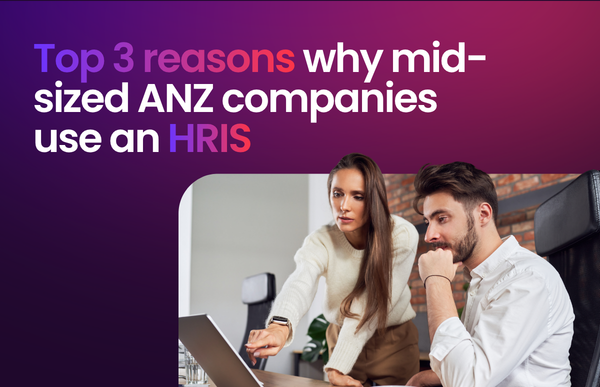
Mid-sized companies in ANZ are under pressure to improve productivity and make better workforce decisions, yet only 23% of Australian organisations and 18% in New Zealand have a fully centralised platform across HR, payroll and workforce management (ELMO 2026 HR Industry Benchmark Report).
Here are three reasons why ANZ mid-sized companies make the switch to an HRIS like ELMO, brought to life through real customer stories.
Compliance is often where the limits of disconnected processes become visible first. When employee, licence, leave and payroll information is spread across systems and local files, HR spends more time finding, checking and reconciling data before it can act.
For organisations operating across multiple states, the challenge extends to different workforce conditions, leave requirements, locations and rostering rules. Having a complete HRIS can help bring these processes into one connected view. Australian construction company Stabilised Pavements shows what this can look like in practice.
With roughly 300 employees working across regional depots and multiple states, the organisation moved compliance and people records out of local folders into ELMO. This created one source of truth for licences, competency verifications, health surveillance, contracts, file notes and other HR data. Checking licences for operators across New South Wales is now reduced from three hours to half a day to around five minutes.
See how Stabilised Pavements did it.
The same data gaps that make compliance harder can also limit growth. As an organisation grows and adds people, inconsistent records make it harder to understand the workforce the business has today and the workforce it needs next.
Having an HRIS supports this growth and change without forcing your team to rebuild its processes each time the organisation reaches a new stage.
This matters because growth decisions are only as useful as the information behind them. When reporting depends on manually combining spreadsheets, it takes longer to understand where the workforce is changing and what action leaders should take next.
When Puretec, an Australian water filtration manufacturer, grew from 86 to 130 employees in two years, job titles became inconsistent, roles were duplicated and workforce reporting remained heavily reliant on spreadsheets. This made it harder to produce accurate headcount figures, track vacancies and align HR and finance data.
Puretec moved to a position-led workforce structure in ELMO, standardised job titles, consolidated position descriptions and created a more consistent way to manage roles, reporting and organisational design. They now have a clearer view of filled and vacant positions across ANZ and more reliable workforce data for leadership conversations.
See how Puretec did it here.
A connected data foundation is also what makes automation useful. With 27% of Australian HR leaders citing lack of time as a productivity barrier (ELMO’s HR Industry Benchmark Report), workflows and reminders are most effective when they are triggered by reliable information and visible to the people responsible for the next step.
Understand which manual tasks create the most risk or rework, then choose a system that can support a better process. Automation is most valuable when it removes a specific source of rework, creates visibility and gives HR capacity back. Sexual Wellbeing Aotearoa demonstrated how automation can reduce HR administration when it came to managing recruitment and compliance.
With around 200 employees, 25 clinics and a two-and-a-half-person HR team, compliance tracking for practising certificate renewals and driver’s licence checks used to be done manually in spreadsheets. But they’re now triggered automatically within the platform.
As Head of People and Capability Hayley Hachey explains, “Everything I’ve been setting up in the system I’ve done in a way that we don’t need to touch anything. It’s automatically doing what it needs to do, and we just have oversight in terms of reporting.” For a regulated health organisation, the shift from reactive tracking to real-time visibility and reporting was a huge boost.
Read Sexual Wellbeing Aotearoa full story.
For mid-sized Australian organisations, the case for a complete HRIS is building the operating foundation needed to manage a more complex workforce with confidence.
When this happens successfully, HR can reduce administrative friction, managers can act with greater clarity and business leaders can make decisions from a more reliable view of the workforce.
For most mid-sized Australian businesses, the best HRIS combines local payroll, Modern Awards, STP support, core HR, built-in AI features and local expert support. ELMO Software is a strong HRIS choice for mid-sized businesses that need connected HR, payroll and workforce management with Australian and New Zealand requirements in mind.
An HRIS gives growing ANZ mid-sized businesses a consistent foundation for employee data, workflows and reporting. As headcount, locations and HR requirements change, the organisation can add employees, sites or features without rebuilding every process in spreadsheets or replacing its core system. ELMO Software has solutions designed to scale as organisations grow.
An HRIS helps multi-site organisations manage employee information and HR processes from a shared platform, while supporting different workforce types and locations. Employee details, documents, leave, training, onboarding tasks and other people processes can be managed through consistent workflows instead of separate spreadsheets, email chains or local files.
ELMO is designed to support multi-site operations and diverse worker types through a unified employee system of record, connected workflows, integrations and workforce insights.
An HRIS can help by keeping employee information, workflows and reporting in one place, while connecting HR data with payroll. This gives HR teams a more consistent way to manage people across different locations and support the requirements relevant to their workforce. For example, ELMO Software centralises employee data and supports connected workflows across office, frontline, casual and shift workforces, and ELMO Payroll supports Australian Single Touch Payroll (STP) Phase 2, New Zealand Payday Filing and KiwiSaver, as well as ABA bank files and SuperStream.
An HRIS reduces manual work by centralising employee data, automating repeatable workflows and giving employees access to self-service tools. This can reduce duplicate data entry, routine enquiries, manual approvals and the need to update multiple records when information changes.
The ELMO-commissioned Forrester Consulting Total Economic Impact™ study modelled a representative Australian organisation with 500 employees and a seven-person HR team. It estimated more than 23,700 hours reclaimed each year, including 2,184 hours saved on HR administration and a 90% reduction in the time taken to action HR and finance tasks.
Here are important questions to consider before :