 Platform
  Hire
Hire  Schedule
  Pay
Pay  Develop
  Plan
Plan  By industry
  By role
  By use case
  Customer Success
  Implementation
  Training & Development
  Partner Program
  Partner Finder
  Partner Stories
  Flare Employee Benefits
 A smarter way to structure your workforce
People move. Structure should not.
Create a stronger foundation for workforce planning with a Position Led structure, unlocking stategic capabilities to level up your HR.
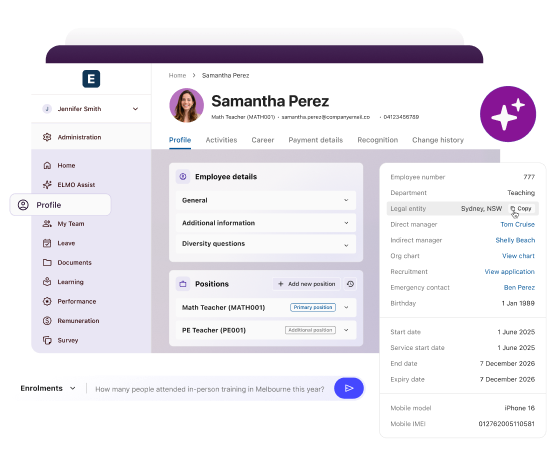
What is a Position-led structure?
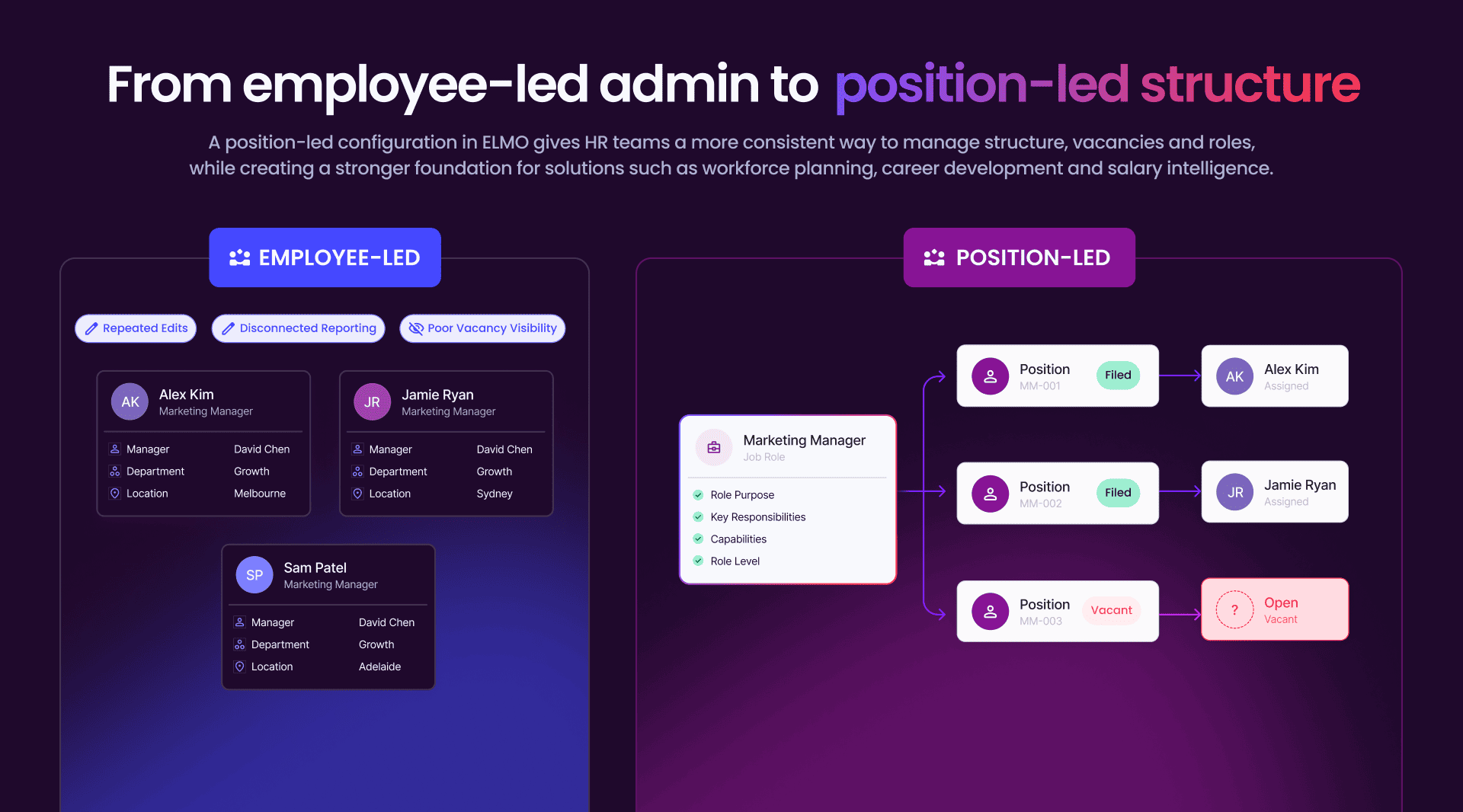
Instead of carrying structure on each employee profile, employees are assigned into positions, creating a more stable, scalable way to manage roles, vacancies and reporting lines.
Why it’s better
Less Admin
Better visibility
Stronger role consistency
Smarter planning
What a position-led unlocks with ELMO
Capability frameworks
Career Development
Career Explorer
Salary intelligence
Workforce design
Capability forecast
How it works
Define the Job Role
Create the Position
Assign the employee
Built for connected workflows
Frequently asked questions
Position-Led means positions exist independently of the people in them, so you can manage vacancies, reporting lines and departments even when a role is empty.
It creates a role-centric structure where each position acts as a central hub for reporting lines, departments and locations, and employees inherit the data of the position they step into.
Yes. Existing customers can remain on employee-led for the foreseeable future, but access to new strategic capabilities such as Workforce Design requires Position-Led configuration.
Recruitment teams can raise requisitions directly from the org chart or Recruitment module, and position descriptions can flow from HR Core through to job ads for better consistency and standardisation.
In an employee-led model, structure is built around individual employee profiles. In a position-led model, the position becomes the structural record, giving you a more scalable blueprint of the organisation.
ELMO will guide you through every step of the setup or migration process.
We’ll help you prepare your departments, locations, positions and user data, review your Position Dependencies report, and run baseline reports so the new structure can be validated with confidence.
ELMO will continue to support your current structure, but t new HR Core capabilities such as Workforce Design are built on Position-Led as the foundation, so they are not available without migrating.